
Navigating the Howey Triangle: SEC charts token taxonomy
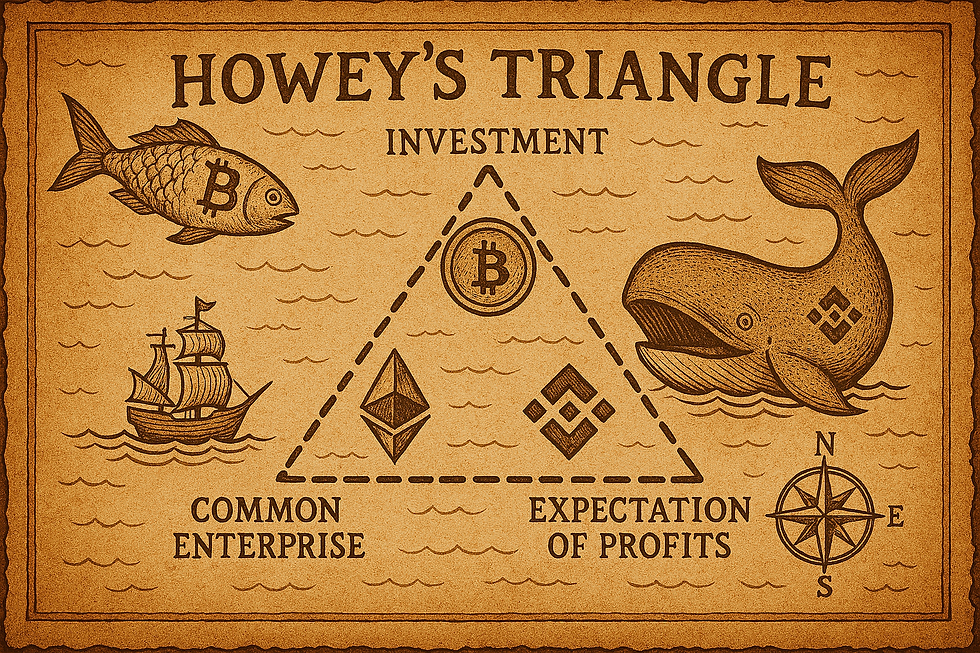
In a recent speech, the Securities and Exchanges Commission (SEC) Chairman, Paul Atkins, tackled one of the most vexed issues in relation to cryptocurrency, the application of the US securities laws.
The speech shed more light on ‘Project Crypto’, the commission's flagship initiative to drive America’s digital finance revolution. The SEC Chairman announced earlier this year plans to facilitate US financial markets to move on-chain and renewed his call to embrace market innovation at the Fordham Blockchain Regulatory Symposium.
Atkin’s speech at the Federal Reserve Bank of Philadelphia focused on the application of federal securities laws to tokens and related transactions. He speech touched on three key themes:
(i) a clear token taxonomy;
(ii) the application of the Howey test to investment contracts; and
(iii) what this could mean in practice for innovators, intermediaries and investors.
Commenting on whether crypto assets are securities, Atkins said that current legislation:
“crypto asset” is not a term defined in the federal securities laws. It is a technological description. It tells you something about how records are kept and value is transferred. But it says little about the legal rights attached to a particular instrument or about the economic reality of a particular transaction, which are key to determining whether something is a security.
Atkins continued:
I believe that most crypto tokens trading today are not themselves securities. Of course, it is possible that a particular token might have been sold as part of an investment contract in a securities offering. That is not a radical statement; it is a straightforward application of the securities laws.
Atkins outlined his current thinking on token taxonomy. He is of the opinion that digital commodities, network tokens, digital collectibles, and digital tools are not securities. He does maintain that tokenised securities are and will continue to be securities.
Atkins went on to consider the consequences of the Howey test which is used to determine whether a transaction is an investment contract. In Atkins’ view crypto assets can be part of or subject to an investment contract despite not being securities themselves. This begs the question as to how one separates a non-security crypto asset in an investment contract. Atkins resolves this:
the issuer either fulfills the representations or promises, fails to satisfy them, or they otherwise terminate
In other words, non-securities crypto assets can be accompanied by certain representations or promises to satisfy the Howey test. This allows for multiple propositions: once an investment contract has run its course or expires by its own terms, the token may continue to trade but is no longer considered a securities transaction. Accordingly, crypto assets may be initially represented as securities and later change form. For example, a token may be sold to sophisticated investors in private sales as a security before trading as a commodity in secondary markets.
According to Atkins:
too many have asserted the view that if a token was ever subject to an investment contract, it would forever be a security. This flawed view extends even further presuming that every subsequent trade, everywhere and always, is a securities transaction.
Atkins analogized the position of crypto assets to orange groves in the Howey case, that is, the fact that the orange groves were found to be the subject of an investment contract did not render them inherently a security. In Atkin's view, a token can form the subject matter of an investment contract before evolving into a commodity. In the same way, an orange grove is not rendered a security for all time just because it was once the subject of an investment contract, it can evolve into a golf resort and serve another purpose.
Commissioner Peirce has rightly observed that while a project’s token launch might initially involve an investment contract, those promises may not remain forever. Networks mature. Code is shipped. Control disperses. The issuer’s role diminishes or disappears. At some point, purchasers are no longer relying on the issuer’s essential managerial efforts, and most tokens now trade without any reasonable expectation that a particular team is still at the helm.
Atkins' approach appears to be at odds with ASIC’s views as set out in its digital asset guidance in INFO225 in certain respects. Specifically, ASIC has adopted the view that a wide range of tokens may qualify as financial products beyond tokenised securities. In ASIC's view, a token bundled together with other products and service may form a single arrangement. Atkins takes a more liberal approach and seeks to balance competing policy objectives. Atkins nevertheless acknowledges in strong terms the need to enforce against fraud and illicit conduct.
The reality is that if the United States insists on making every on-chain innovation run the through a securities-law minefield, those innovations will migrate to jurisdictions that are more willing to distinguish among different kinds of assets, and more willing to write down the rules in advance. Instead, we are going to do what regulatory agencies are supposed to do. We are going to draw clear lines and explain them in clear terms.
Chair Atkins concluded his remarks with a call to establish rules for crypto-asset markets that are knowable, reasoned and appropriately constrained. This does not mean deciding the fate of the market, but rather balancing the policy objectives of facilitating markets, innovation and protecting investors.
Written by Steven Pettigrove, Luke Higgins and Sophie Nguyen


